
How to Choose Fragrance Oils for Candles: A Perfumer's Guide
The right fragrance oil smells balanced on a perfumer strip after 30 minutes, throws scent across a room when burned, and comes with an IFRA certificate you can actually read. Everything else — the pretty bottle, the poetic name, the supplier's marketing — means nothing if those three boxes aren't checked. I graduated from perfumery school in Grasse, France, and I've been formulating and evaluating fragrance oils from my Dubai workshop for years. Here's exactly how I pick the ones worth putting into wax.
How I Actually Evaluate a Fragrance Oil
Most candle makers open a bottle, take a sniff, and decide on the spot. That tells you almost nothing. A fragrance oil has to survive being mixed into hot wax, curing for a week, and then being slowly vaporized by a flame. The way it smells straight from the bottle is barely relevant.
The Perfumer Strip Test
I dip a paper perfumer strip into the oil and let it dry. Then I smell it at three intervals — immediately, after 15 minutes, and after 30 minutes. That first hit is just the top notes burning off. The 15-minute mark gives me the heart of the fragrance. And the 30-minute mark tells me what the base notes are doing, which is honestly the most important part for candles. If the fragrance is flat or chemical-smelling at 30 minutes, I move on. No amount of wax is going to fix a weak dry-down.
Cold Throw vs Hot Throw
Cold throw is the scent you pick up from an unlit candle sitting on a shelf. Hot throw is what fills the room when the flame is going. They are two completely different performances, and a fragrance that excels at one can completely fail at the other.
I've tested oils that smelled incredible cold — rich, complex, layered — and then threw almost nothing once lit. The reverse happens too. You genuinely can't predict hot throw from cold throw alone. The only way to know is to pour test candles and burn them.
My Workshop Testing Protocol
Here's what I actually do for every new fragrance oil that comes through my workshop:
- Strip test — Evaluate dry-down at 0, 15, and 30 minutes
- Pour three test candles — Same wax, same wick, same container, at 8% fragrance load
- Cure for 10 days minimum — I label each jar with the date and fragrance code
- Cold throw check — Open the jar, smell from 15cm away, rate it 1-5
- Burn test in a closed room — Light the candle, leave the room, come back after 20 minutes and rate the throw
- 4-hour burn intervals — Burn through the full life of at least one candle, checking scent consistency
That last step catches problems nothing else will. Some fragrances start strong and fade halfway through the candle's life because the lighter molecules burned off during curing and the first few burns. A fragrance that doesn't hold up through a full burn cycle doesn't go into my product line.
The Note Pyramid — Explained Without the Jargon
Every fragrance has a structure. Perfumers call it a pyramid, but it's really just three layers that reveal themselves at different speeds.
Top Notes — The First Impression
These are the light, fast-evaporating molecules. Citrus, mint, light fruits, ozonic accords. You smell them immediately when you light a candle, but they disappear within the first 15-20 minutes of burn time. A fragrance built mostly on top notes will smell great for the first few minutes, then go quiet. I see this mistake constantly with cheaper citrus-heavy oils.
Heart Notes — The Main Event
Rose, jasmine, spices, herbs, tea — these molecules sit in the middle weight range. They show up after the top notes fade and carry the bulk of your candle's scent experience. When someone says a candle "smells amazing," they're usually talking about the heart notes. This is where I spend most of my evaluation time.
Base Notes — The Anchor
Oud, sandalwood, vanilla, amber, musk, vetiver. Heavy molecules that evaporate slowly and linger in a room long after you blow out the flame. For candles, strong base notes are critical. They give the fragrance staying power and depth. A candle with weak base notes smells thin, no matter how nice the top and heart are.
For the Dubai market specifically, base-heavy fragrances dominate. My customers here want depth, warmth, and richness — qualities that come from a solid base note foundation.
IFRA Compliance — What It Actually Means for You
IFRA stands for the International Fragrance Association. They test fragrance ingredients and publish maximum safe usage rates for different product types. Candles fall under Category 12 in their system.
Plain Language Version
An IFRA certificate tells you: "At X% usage in a candle, every single ingredient in this fragrance oil is within tested safety limits." That percentage matters. A fragrance might be safe at 8% but exceed limits at 12%. The certificate spells out exactly how much you can use.
Why You Should Care
When your candle burns, it releases fragrance molecules into the air that people breathe. Some aromatic compounds, above certain concentrations, are skin sensitizers or respiratory irritants. The IFRA safe use standards exist to keep those compounds below harmful levels. If you're selling candles — especially here in the UAE where consumer protection regulations are strict — IFRA compliance isn't optional. It's your baseline responsibility.
What to Demand From Your Supplier
Ask for the IFRA certificate before you buy. It should list the maximum usage rate for Category 12 (candles). If a supplier can't produce this document or tells you it's "not necessary," walk away. Every professional fragrance oil manufacturer provides IFRA documentation as standard practice.
Flash Point — Why This Number Matters
Flash point is the temperature at which a fragrance oil produces enough vapor to ignite near an open flame. For candles, you need a flash point well above your pouring temperature.
The Practical Rule
Most quality candle fragrance oils have flash points between 70-93 degrees Celsius. Your wax pouring temperature is typically 55-70 degrees Celsius depending on the wax type. You want a comfortable gap between the two. If you're pouring coconut wax at 60 degrees Celsius and your fragrance oil has a flash point of 62 degrees, that's cutting it dangerously close. The fragrance can flash off during pouring, creating a fire risk and destroying the scent.
What a Low Flash Point Actually Does
A low flash point doesn't mean your candle will explode on someone's coffee table. It means the fragrance oil can produce ignitable vapor at lower temperatures. During the pouring process, this means lost fragrance and potential safety hazards. During burning, a very low flash point fragrance can cause the flame to flare unpredictably.
Check the technical data sheet. The flash point should be listed clearly. If it's below 65 degrees Celsius, I'd skip that oil for candle use entirely.
What Sells in the Dubai and GCC Market
I've been supplying candle makers across the Emirates for years, and the scent preferences here are distinct from Western markets. Understanding what your local customers want saves you from investing in fragrances that sit on shelves.
The GCC Favorites
Oud is king. A well-crafted oud fragrance oil in a candle sells itself in this region. But it has to be good — people here grew up with real oud, and they can tell when a synthetic oud smells cheap or harsh. After oud, the strongest performers are rose (Taifi rose profiles especially), amber blends, sandalwood, saffron-rose combinations, and bakhoor-inspired accords.
Building Your Scent Collection
If you're launching a candle brand in Dubai, I'd start with five fragrances max:
- One oud-based scent (woody, smoky, complex)
- One floral with regional appeal (rose-oud, jasmine-saffron)
- One warm amber or vanilla-based comfort scent
- One fresh or clean option for variety (white tea, linen, sea salt)
- One seasonal or signature scent that sets your brand apart
You don't need twenty fragrances on day one. Five well-tested, beautifully performing scents will build your reputation faster than a scattered collection of mediocre ones. For a step-by-step walkthrough on actually making your first candle with these oils, my beginner's guide to candle making covers the full process.
FAQ
These are the fragrance questions that come up most often in my Dubai workshop. Fragrance selection is where perfumery meets candle craft — get the technical foundations right, and the creative part becomes the fun part instead of a guessing game.
Recommended resource from International Fragrance Association (IFRA)
IFRA Safe Use Standards and Guidelines→Frequently Asked Questions
Can I use essential oils instead of fragrance oils in candles?
Technically yes, but I don't recommend it for most candle makers. Essential oils have lower flash points, weaker scent throw in candles, and significantly higher cost. A lavender essential oil candle will cost 3-4 times more to produce than one using a quality fragrance oil, with weaker scent performance. Essential oils also degrade faster at high temperatures, which means some therapeutic compounds break down during burning.
What is the maximum fragrance load for candle wax?
Most natural waxes support 8-12% fragrance load by weight. Soy wax typically maxes at 10-12%, coconut wax at 8-10%, and paraffin at 10-12%. Exceeding the maximum causes the wax to sweat (oil pooling on the surface), clogs the wick, and creates a fire safety risk. Your wax manufacturer's specification sheet will state the maximum load. Always stay within it.
Why does my candle smell strong when cold but weak when burning?
This is the most common fragrance complaint. The usual causes are: wick too small (insufficient heat to vaporize the fragrance), fragrance oil with low-volatility compounds that don't release well at burning temperatures, or insufficient cure time. Try a larger wick first, as this is the most frequent fix. Also ensure you cured the candle for at least one week.
What does IFRA compliance mean for candle fragrance oils?
IFRA (International Fragrance Association) sets maximum usage rates for fragrance ingredients based on safety testing. An IFRA-compliant fragrance oil has been formulated so that when used at the recommended percentage, all individual ingredients fall within safe usage limits for the specified product category (candles fall under Category 12). It's the global safety standard for the fragrance industry.
How many fragrances should a new candle brand start with?
Three to five. This gives customers variety without overwhelming your production, testing, and inventory. Choose a range that covers different scent families — for example, one floral, one woody, one fresh, and one gourmand. You can expand your line after you understand which scents resonate with your specific customer base.
About the Author
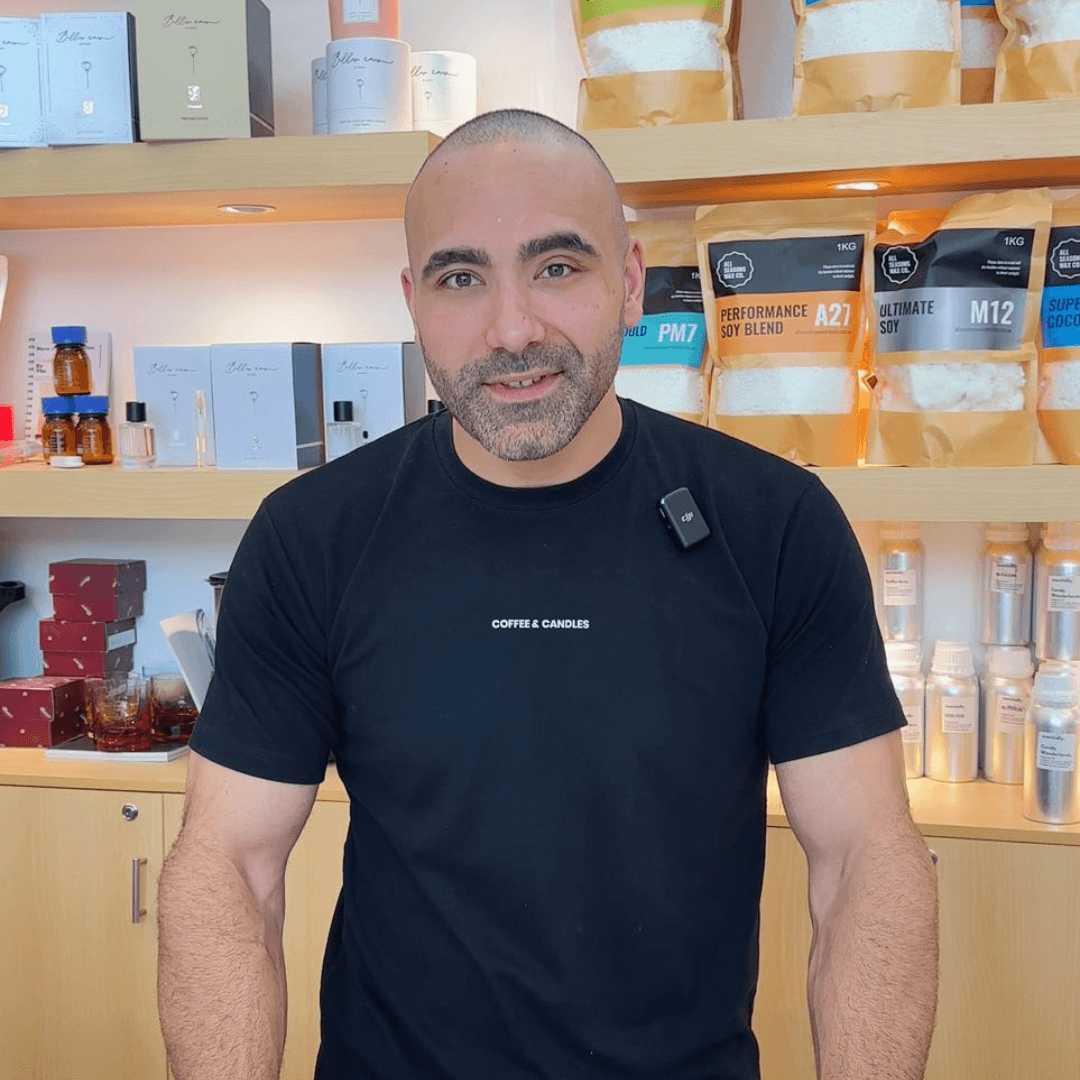
Ahmed Al Hassoni
Perfumer trained in Grasse, France. I founded CandleStart — the GCC's largest candle and perfume-making supply hub — and have trained hundreds of makers across the region. I also build tools for the fragrance industry through Olfactal and WaxHippo.
Related Articles

How to Make Candles at Home: A Complete Beginner's Guide
Learn how to make candles at home step by step. From choosing wax and wicks to pouring and curing, this Dubai-based guide covers everything beginners need.

Coconut Wax vs Soy Wax: Which Is Better for Candles?
Coconut wax vs soy wax compared on burn quality, scent throw, sustainability, and cost. Expert breakdown from Dubai's certified candle wax supplier.